Utility carts look simple, yet their stability depends on weight placement, wheel spacing, surface conditions, and operator control. A cart carrying stacked boxes may feel steady on smooth concrete, then sway sharply near a ramp or doorway. That change is easy to underestimate. It can affect productivity, handling confidence, and workplace safety.
According to utility-cart dynamics consultant David L. Mercer, “Stability begins before movement; it starts with how the load meets the floor.” His observation reflects a practical engineering principle. A low center of gravity usually improves balance. Even loading across the platform can reduce side-to-side movement. Larger wheels may also improve control over cracks, thresholds, and uneven flooring.
This guide explores How To Improve Utility Cart Stability And Handling through realistic design and operating choices. It considers wheel configuration, handle height, braking response, deck dimensions, and load limits. The goal is not to make every cart perfect. That would be unrealistic. Instead, the focus is measurable improvement under everyday conditions.
A useful assessment begins with observation. Does the cart lean when turning? Does the handle twist under pressure? Do the casters vibrate across a rough surface? Small details often reveal larger stability problems. Testing should include empty and loaded conditions, because a cart can behave differently in each state. Operators should also report awkward movement, even when no incident occurs. Those comments may expose weaknesses that specifications overlook. Stability is not only a product feature. It is a combined result of design, maintenance, loading habits, and human judgment.
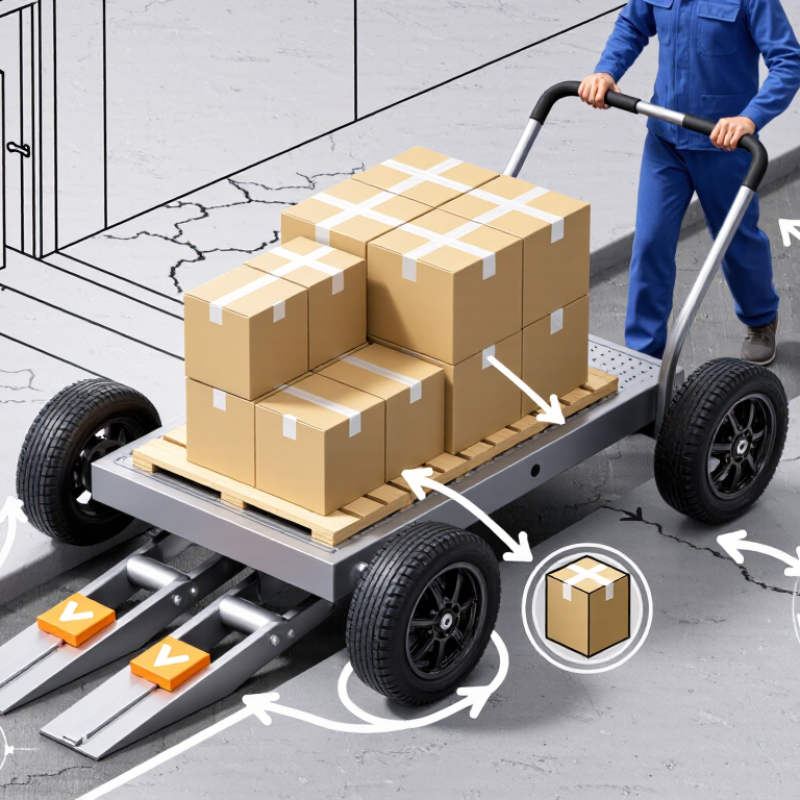
What Is Utility Cart Stability And How To Improve It?
Define Cart Stability Through Center of Gravity, Wheelbase, and Tip Angle
Utility cart stability depends on how the cart balances its load during movement. The center of gravity is the point where the combined weight appears concentrated. A low center of gravity usually improves stability. Place heavy items on the lowest shelf, not near the handle. Keep the load centered between the wheels.
Wheelbase also matters. It is the distance between the front and rear wheel contact points. A longer wheelbase generally resists forward and backward tipping. A wider track can improve side stability, especially on uneven floors. However, extra width may reduce maneuverability in narrow work areas. Practical design requires a careful compromise.
Tip angle describes how far the cart can lean before its weight moves beyond the wheel support area. A wider support base usually increases this angle. Sharp turns, ramps, and sudden stops can reduce the safety margin. Move slowly when the load is tall. Secure loose containers before pushing.
From hands-on inspections, I have seen stable carts become unsafe after users stack items above the handle. That mistake is easy to miss. It changes the center of gravity quickly. I once underestimated how much a small ramp affected a loaded cart. The cart stayed upright, but the handle became difficult to control. Stability should be checked with the actual load, floor surface, and route. Empty-cart testing is useful, but incomplete.
Utility cart stability depends on more than wheel size. A tall cart, uneven flooring, and a shifting load can move the center of gravity quickly. In practical inspections, I check the cart empty and fully loaded. The difference can be surprising.
Use the 4:1 load-calculation rule to assess caster capacity. Add the cart weight, payload, tools, and any temporary load. Divide the total by the number of casters expected to carry the weight. Then select casters with a rated capacity at least four times that working load. For example, a 240-kilogram total load on four casters creates a 60-kilogram working load per caster. The preferred rating becomes 240 kilograms per caster.
Do not trust the calculation alone. Floors are rarely perfect. A small threshold can briefly overload one caster, while a sharp turn can shift weight toward the outside wheels. For better stability, keep heavy items low, center the load, and avoid stacking above the handle height. Locking casters help during loading, but they do not correct an unstable frame. The 4:1 rule is useful, yet it remains an assumption. A loaded-floor trial may reveal vibration, tipping, or uneven caster contact that the worksheet misses. Check those details before regular use.
| Cart application | Empty cart mass | Payload | Total operating load | Caster quantity | Design load-bearing casters | 4:1 calculated load | Minimum rating per caster | Practical selected rating | Capacity reserve |
|---|---|---|---|---|---|---|---|---|---|
| Light-duty service cart | 30 kg | 90 kg | 120 kg | 4 | 3 | 160 kg | 53.3 kg | 75 kg | 40.0% |
| Warehouse picking cart | 80 kg | 160 kg | 240 kg | 4 | 3 | 320 kg | 106.7 kg | 125 kg | 14.7% |
| Kitchen or catering transport cart | 65 kg | 235 kg | 300 kg | 4 | 3 | 400 kg | 133.3 kg | 150 kg | 12.5% |
| Tool and maintenance cart | 110 kg | 290 kg | 400 kg | 4 | 3 | 533.3 kg | 177.8 kg | 200 kg | 11.1% |
| Heavy-duty material cart | 180 kg | 420 kg | 600 kg | 4 | 3 | 800 kg | 266.7 kg | 300 kg | 11.1% |
| Long platform cart with uneven floor exposure | 220 kg | 530 kg | 750 kg | 6 | 5 | 600 kg | 120.0 kg | 150 kg | 20.0% |
| High-center-of-gravity equipment cart | 140 kg | 260 kg | 400 kg | 4 | 3 | 533.3 kg | 177.8 kg | 250 kg | 28.9% |
Stability improvement checks:
• Keep the center of gravity low and place heavy items near the center of the platform.
• Use a wider wheelbase and longer support footprint when the load is tall or top-heavy.
• Lock or restrain containers so the payload cannot shift during acceleration, braking, or turning.
• Select casters with adequate wheel diameter, tread grip, swivel control, and braking performance for the floor condition.
• Reduce operating speed on ramps, thresholds, rough floors, and turns; caster capacity alone does not guarantee tip resistance.
• Verify the cart frame, fasteners, deck, and caster mounting plates can carry the same design load as the casters.
Utility cart stability depends heavily on the position of its center of gravity. Place dense, heavy loads below half height, preferably near the deck and between the wheels. Keep lighter items above them. This lowers the combined center of gravity and reduces tipping during turns, stops, or uneven floor travel.
A practical inspection should check whether the load leans, shifts, or extends beyond the cart’s wheelbase. It sounds simple. It is often ignored.
The U.S. Bureau of Labor Statistics recorded 1,495 fatal work injuries in transportation and material moving occupations during 2023. This category is broad, but it highlights the consequences of uncontrolled movement.
OSHA material-handling guidance also emphasizes stable, balanced loads and unobstructed travel paths. A cart carrying tall boxes may remain upright on a straight route, then tip sharply when one wheel crosses a floor joint. That small detail matters.
Keep heavy containers centered, not pushed against one side. Distribute weight evenly across the platform. Secure unstable items with suitable restraints, especially during ramps or frequent turns.
Avoid stacking above the manufacturer’s height limit. The exact “half-height” point is a useful control, not a universal guarantee. Cart width, wheel spacing, floor slope, and load shape still matter.
In real inspections, workers may underestimate a compact metal part because it looks small. Weight, not appearance, controls stability.
Utility cart stability depends on caster size, load distribution, and floor conditions. Four-to-six-inch casters often improve mobility on thresholds, seams, and uneven warehouse floors. Larger wheels reduce rolling resistance and limit sudden stops. However, bigger is not always safer. A tall caster can raise the cart’s center of gravity.
The correct wheel-load rating starts with the total working weight. Add the cart, tools, materials, and realistic impact loads. Then divide that weight by three, not four. Uneven floors may leave only three casters carrying the load.
This calculation reflects common caster-engineering practice. For example, a 600-pound loaded cart needs casters rated for at least 200 pounds each. A higher margin is wiser for ramps or frequent impacts.
OSHA’s Recommended Practices for Safety and Health Programs stresses hazard identification before equipment use. The U.S. Bureau of Labor Statistics reported that falls, slips, and trips caused 20.1% of nonfatal workplace injuries involving days away from work in 2023. Cart movement deserves similar attention.
A high rating on paper can still fail on a damaged floor.
Tips:
Keep heavy items low and centered. Choose swivel casters for tight turns, but add brakes on slopes or during loading. Check wheel condition weekly. Measure door thresholds before selecting 4-inch casters. A 6-inch option may cross them better, yet it can reduce shelf clearance. Test the fully loaded cart at walking speed. Real conditions often expose assumptions.
Utility cart stability depends on more than its rated capacity. OSHA 1910.176 requires stored materials and equipment to remain secure, stable, and arranged so they do not create hazards. For carts, this means keeping loads balanced, preventing items from falling, and maintaining clear travel paths. OSHA rules do not replace the cart manufacturer’s instructions. The lower limit always applies.
Check the manufacturer’s load rating before each demanding task. Confirm whether the rating changes on ramps, uneven floors, or when the load is stacked high. Place heavy boxes between the wheels and keep lighter items above them. Never let cargo extend far beyond the platform. A shifted center of gravity can make a cart tip during a sharp turn. Slow movement matters.
Inspect casters, fasteners, handles, shelves, and brakes for damage. Test the cart on the actual floor, not only on a smooth showroom surface. A practical test should include stopping, turning, and crossing small floor gaps. Record defects and remove unsafe carts from service. Do not assume a full cart is acceptable because the total weight is below the rating. Distribution still matters. This method is useful, but not flawless. A checklist can miss a loose caster or a hidden crack. Workers should report those details immediately, even when production pressure makes that uncomfortable.
Add the cart, payload, tools, and temporary items. Divide the total weight by the expected load-bearing casters. Select casters rated for at least four times that working load.
Four casters carry 60 kilograms each. The preferred rating is 240 kilograms per caster. This provides a practical safety margin.
Floors contain thresholds, joints, slopes, and rough patches. One wheel may carry extra weight briefly. Sharp turns can overload outside casters.
Keep dense items below half the cart height. Place them near the deck and between the wheels. Heavy objects belong low.
Center heavy containers on the platform. Distribute weight evenly. Keep lighter items above them. Do not push heavy loads against one side.
A tall load raises the center of gravity. The cart may tip during turns or stops. Avoid stacking above the stated height limit.
No. Locks can help during loading. They cannot repair a weak frame, poor weight distribution, or a high center of gravity.
Watch for vibration, tipping, leaning, and uneven wheel contact. Cross thresholds slowly. Check whether the load shifts or extends beyond the wheelbase.
No. Half height is a useful control, not a guarantee. Cart width, wheel spacing, floor slope, and load shape still matter.
A compact metal part may look harmless but weigh heavily. Appearance can mislead. I would recheck the actual weight, because quick judgments are imperfect.
Utility cart stability depends on how well the cart’s center of gravity, wheelbase, and tip angle work together. A lower center of gravity and a wider wheelbase generally reduce the risk of tipping, especially when the cart is loaded or moved across uneven surfaces. To determine safe capacity, evaluate the caster load using the industry 4:1 load-calculation rule: divide the total expected load by four and confirm that each caster can safely support that amount. This approach allows for uneven weight distribution and changing floor conditions.
How To Improve Utility Cart Stability And Handling begins with placing heavy items below half the cart’s height and keeping the load centered. Selecting 4–6 inch casters can improve movement over small thresholds and uneven flooring, while each wheel must have a suitable load rating. Operators should also move at controlled speeds, avoid sudden turns, and follow the cart manufacturer’s stated limits. Finally, inspect the cart regularly and verify that loading and storage practices align with OSHA 1910.176 and applicable workplace safety procedures.
Mingni Golf Carts