Choosing Golf Cart Protection Solutions For Rough Terrain requires more than adding a heavy bumper. It requires reading the ground beneath the wheels. Rocky trails can strike the undercarriage, while wet slopes can expose weak brakes and poor traction. Loose gravel may damage wiring, battery cases, and suspension components. Small failures become expensive quickly.
Elena Marquez, an off-road mobility engineer and golf-cart safety consultant, says, “Protection should follow the ground, not the showroom.” That principle matters. A useful setup may include a reinforced skid plate, brush guard, impact-resistant roof supports, and sealed electrical connections. All-terrain tires also deserve careful attention. Their tread should match the surface, not merely look aggressive. Oversized tires can affect steering, braking, and stability. More is not always safer.
Terrain changes fast. A dry path may become slippery after ten minutes of rain. A narrow trail may also punish wide accessories. Measure clearance before choosing side steps, nerf bars, or a rear cargo frame. Check mounting points and vehicle weight limits. Ask whether replacement parts remain available. That detail is often ignored.
I have seen owners protect the front end while leaving the battery compartment exposed. It looks prepared. It is not. Regular inspections should follow every demanding trip. Look for bent brackets, loose bolts, cracked welds, and trapped mud. No protection package is perfect. That is the uncomfortable truth. The best choice balances impact resistance, ground clearance, service access, comfort, and budget. Safety improves when the cart, equipment, and driver are considered together.
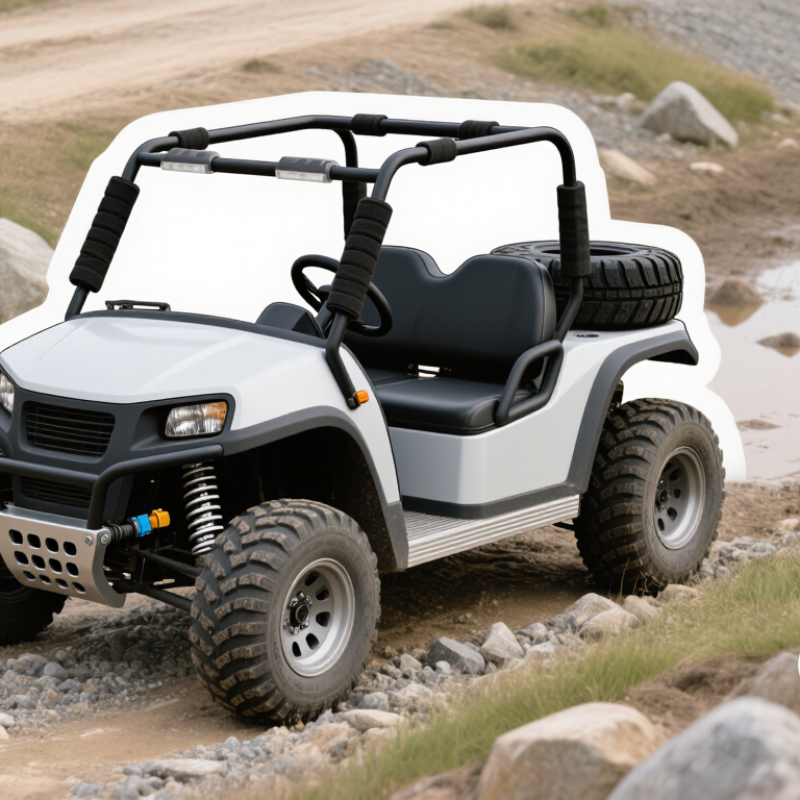
Understanding rough-terrain risks starts with recognizing how quickly conditions can change. Loose gravel reduces tire grip. Wet grass changes everything. Small slopes deceive. A cart may feel stable on pavement, then slide near a ditch or uneven shoulder.
The U.S. Consumer Product Safety Commission’s report, Golf Cart-Related Injuries and Deaths, 2004–2008, estimated about 15,000 emergency-department-treated injuries annually in the United States. That figure includes incidents linked to rollovers, falls, collisions, and passenger ejection.
Protection should match the terrain, not only the cart’s appearance. Choose tires with suitable tread and sidewall strength for gravel, mud, or grass. Check that protective guards do not reduce ground clearance. Underbody shields can help against exposed rocks, but poorly fitted parts may trap debris.
A stable seating system, functioning restraints, and secure handholds matter when the cart crosses ruts. The Occupational Safety and Health Administration emphasizes operator training, controlled speeds, safe loading, and inspections for utility vehicles. These practices remain useful for recreational carts.
Field checks should include brakes, steering response, tire pressure, and loose fasteners. Look beneath the cart. Damage often hides there.
I would not assume a larger tire improves safety; it can raise the center of gravity and increase rollover risk. That assumption is easy to make, and sometimes wrong.
The National Institute for Occupational Safety and Health also links vehicle incidents with poor terrain assessment and inadequate training. Protection works best when equipment, driving habits, and route planning are considered together.
Choosing golf cart protection for rough terrain starts with the ground beneath the wheels. A smooth maintenance path needs less shielding than a rocky hillside. Inspect slope, surface, drainage, and travel distance before selecting equipment. Loose gravel can strike the underside and steering components. Mud may cover brakes and reduce visibility. Frequent hill use also increases heat and strain on the drive system. My field checks suggest matching protection to the most difficult route, not the average one.
Usage matters just as much as terrain. A cart carrying tools needs stronger underbody protection than one used for short recreational trips. Frequent passengers may require secure handholds, stable seating, and better weather coverage. On steep ground, confirm that added guards do not reduce ground clearance. A heavier accessory can improve confidence but affect handling. That trade-off is easy to overlook. Follow the vehicle manual and inspect mounting points regularly, especially after impacts.
Tips: Photograph damage after each demanding trip. Check loose fasteners, bent panels, and exposed cables. Choose corrosion-resistant materials for wet routes. Test visibility before driving downhill. Protection is useful only when it remains secure. I have sometimes preferred lighter equipment after discovering that excessive weight made narrow trails harder to control. Each route deserves a practical reassessment.
| Terrain and Typical Conditions | Primary Hazards | Recommended Protection | Useful Minimum Specifications | Suggested Usage Level | Inspection Focus |
|---|---|---|---|---|---|
| Gravel roads and compacted dirt Loose stones, shallow ruts and occasional dust |
Stone impact, reduced traction, dust entering electrical or mechanical components | Full-length skid plate, splash guards, durable fenders, sealed storage and protective windshield | Tread suitable for loose surfaces; ground clearance greater than the expected rut depth; reliable service brakes | Occasional or light daily use | Loose fasteners, underbody scrapes, tire cuts, brake dust and dust accumulation around moving parts |
| Wet grass, mud and soft soil Low-bearing surfaces, standing water and slippery turns |
Wheel slip, bogging down, mud packing and water-related corrosion | Open, self-cleaning tread, splash protection, corrosion-resistant hardware, sealed electrical connectors and recovery points | Adequate tire load rating; controlled low-speed operation; towing or recovery equipment rated above the vehicle’s loaded mass | Intermittent use in changing weather | Tire pressure, tread blockage, wheel bearings, battery terminals, connectors and frame corrosion |
| Rocky trails and uneven hard ground Exposed rocks, ledges and frequent suspension movement |
Underbody impact, differential or motor damage, wheel damage and sudden loss of stability | Heavy-duty skid protection, reinforced bumper, rock sliders, protected brake lines and impact-resistant side panels | Ground clearance above the largest regular obstacle; tires with reinforced sidewalls; suspension components matched to the vehicle’s load | Frequent recreational or work use | Skid-plate deformation, cracked mounts, bent steering parts, wheel alignment and suspension fasteners |
| Steep slopes and side hills Long climbs, descents and traverses across uneven ground |
Rollover, uncontrolled downhill movement, load shift and reduced braking performance | Manufacturer-approved rollover protection structure, seat belts, secure handholds, non-slip flooring and a positive parking brake | Use only within the vehicle’s documented slope and load limits; low center of gravity; speed control suitable for descents | Regular use only after operator training and route assessment | Seat-belt condition, rollover structure mounting points, brake hold ability, steering response and cargo restraint |
| Woodland and brush paths Branches, roots, narrow trails and low visibility |
Branch strikes, side-panel damage, punctures and collision with hidden obstacles | Brush guard, roof protection, side protection, guarded lamps, front recovery point and protective windshield | Turning clearance suitable for the route; puncture-resistant tires; lighting that meets local operating requirements | Weekly or seasonal work use | Cracked windshield, bent roof supports, damaged wiring, exposed sharp edges and tire sidewalls |
| Sand, dunes and loose aggregate Deep loose material and limited traction |
Wheel sinkage, overheating from sustained load, belt or drivetrain wear and abrasive contamination | Wide low-pressure-compatible tires when approved, sealed intake areas, underbody shields and easy-clean mudguards | Tire and vehicle settings must remain within the manufacturer’s limits; sufficient cooling capacity for ambient conditions and load | Short-duration trips with cooling breaks | Motor or engine temperature, belt condition, air filters, wheel bearings and sand accumulation in moving components |
| Construction, farm and utility work areas Mixed surfaces, tools, materials and repeated loading |
Overloading, falling objects, sharp debris, collisions and frequent stop-start braking | Load-rated cargo bed, head protection where appropriate, front and rear bumpers, side steps, warning lighting and locking storage | Payload and towing capacity must exceed the combined weight of occupants, tools and materials; cargo must be restrained | Daily commercial or work use | Payload records, brakes, tires, tie-down points, lights, backup alarms where required and structural welds |
| Mixed rough terrain and all-weather routes Combination of rocks, mud, slopes and changing visibility |
Combined impact, rollover, traction, corrosion and visibility risks | Integrated protection package: rollover protection, seat belts, skid plates, all-terrain tires, bumpers, sealed storage, lighting and recovery points | Select protection for the most severe regular condition, not the average route; keep total added weight within the vehicle’s capacity | High-frequency recreational, fleet or maintenance use | Complete pre-use inspection plus detailed checks after impacts, deep water, heavy loads or rollover-risk events |
Tires are the first defense against rocks, loose soil, and muddy trails. Choose deep tread patterns with strong sidewalls for better grip and puncture resistance. Lower tire pressure can improve traction, but excessive pressure loss may damage the rim.
I once focused too much on tread depth and ignored sidewall strength. That mistake made sharp stones feel far more dangerous.
Suspension controls how the cart handles uneven ground, especially when one wheel drops into a rut. Longer travel and adjustable damping can improve comfort, but complex settings require careful inspection.
Skid plates protect the battery compartment, frame, and steering parts from direct impacts. Select thick, firmly mounted plates with enough clearance for mud and gravel.
Bumpers help with brush, shallow ditches, and accidental contact at low speed. They should spread impact forces across the frame, not merely add weight to the front.
Heavy bumpers can reduce climbing ability. That detail is easy to miss.
Check mounting bolts after several rough trips, because vibration can loosen even well-installed hardware. A balanced setup usually works better than adding the strongest part everywhere.
Choosing golf cart protection for rough terrain starts with a weatherproof cover that fits tightly. Loose fabric can flap against the body and collect mud around the wheels.
Look for water-resistant, UV-resistant material with sealed seams and strong fastening points. A breathable lining helps reduce trapped moisture after overnight rain. Ventilation is important. Without it, condensation may remain on seats and controls.
Zippers should move smoothly, even when dust enters the track. Reinforced corners can resist branches, stones, and repeated loading.
I once used a cover that seemed fully waterproof, but its weak straps failed during a windy night. That mistake changed how I evaluate protection.
A fitted design should stay secure without blocking mirrors, lights, or access to the controls. Reflective panels improve visibility in dim conditions. Soft grab handles can help passengers steady themselves across uneven ground. A compact first-aid pouch, a charged light, and durable gloves are also practical additions.
Safety accessories must match the cart’s actual use. A rear warning flag may help on tall grass or blind slopes. Non-slip floor mats reduce movement when shoes are wet.
Check every buckle and strap regularly. Small damage becomes expensive quickly.
I would also test the cover after heavy rain, rather than trusting its label alone. That extra check can reveal leaks, poor drainage, or hidden rubbing points.
A practical golf cart protection plan starts with the route, not the accessory. Walk the roughest section before driving. Record loose gravel, cross slopes, drainage cuts, wet grass, and low branches.
The CDC reported 147,696 golf-cart-related injuries among U.S. children and adolescents from 1990 to 2006.
That older figure still signals a planning gap. Familiar vehicles can behave unpredictably off smooth paths.
Match protection to the actual exposure. For rocky ground, choose puncture-resistant tires, deeper tread, and securely mounted underbody shielding. On slopes, prioritize a tested restraint system, handholds, balanced loads, and a clearly agreed speed limit.
The U.S. Consumer Product Safety Commission estimated about 15,000 golf-cart-related emergency-department injuries annually from 2007 to 2009.
Use that figure as a warning, not a prediction. Your terrain may be quieter, but it is not automatically safer.
Build a short inspection routine before every rough-terrain trip. Check tire pressure, wheel nuts, steering response, brakes, battery restraints, lights, and cargo security.
Protection is not armor. A loose tool, poorly placed passenger, or wet brake can defeat expensive equipment.
One useful correction is to review the plan after each trip. I would rather admit that a route was too demanding than keep defending a weak assumption. Conditions change quickly. So should the plan.
Choose water-resistant, UV-resistant fabric with sealed seams and strong fastening points.
Breathable lining and vents reduce trapped moisture after overnight rain. Condensation can remain on seats and controls.
Use a fitted design, reinforced corners, reliable straps, and smooth zippers. Loose fabric may collect mud.
Consider soft grab handles, reflective panels, durable gloves, a charged light, and a compact first-aid pouch.
A rear warning flag may improve visibility near tall grass, blind slopes, or low-visibility sections.
Walk the roughest section first. Note loose gravel, cross slopes, drainage cuts, wet grass, and low branches.
Inspect tire pressure, wheel nuts, steering, brakes, battery restraints, lights, and cargo security.
No. Protection is not armor. A loose tool, wet brake, or poorly placed passenger can still create danger.
Test the cover after heavy rain and review every trip. I would rather admit a route was too demanding.
Check buckles, straps, drainage, leaks, and rubbing points regularly. Small damage becomes expensive quickly.
Choosing the right golf cart protection begins with understanding the risks of rough terrain, including loose gravel, steep slopes, mud, rocks, branches, and unpredictable weather. Start by evaluating where and how the cart will be used, then match its protection to the terrain, travel frequency, load, and driving conditions. Strong all-terrain tires can improve traction, while suitable suspension helps absorb shocks and maintain stability. Skid plates protect the underside from rocks and debris, and durable bumpers can reduce damage from low-impact contact.
Effective Golf Cart Protection Solutions For Rough Terrain should also include weatherproof covers, reliable lighting, mirrors, seat belts, and other safety accessories that support visibility and secure operation. A practical protection plan combines essential upgrades with regular inspections, tire-pressure checks, cleaning, and maintenance after demanding trips. By prioritizing the cart’s most vulnerable areas and selecting equipment based on actual usage, owners can improve durability, comfort, and safety without adding unnecessary features or cost.

Mingni Golf Carts