A utility cart can save time, but the right accessories depend on the work, the route, and the load. A tray that keeps tools steady in a workshop may be awkward on a picnic lawn. Small details matter: wheel size, handle clearance, tie-down points, and how quickly a surface can be cleaned. This 2026 guide to Utility Cart Accessories For Work And Leisure compares practical add-ons for job sites, gardens, events, and weekend outings. It focuses on fit, durability, storage, and everyday handling—not flashy features alone.
For transparency, the quoted specialist below is a fictional composite, not a real person or a sourced interview. Utility-cart specialist “Casey Rowan” offers this guiding thought: “A useful accessory should make the cart safer, simpler, or easier to adapt—not just more crowded.” That is a sensible test. A removable bin can separate clean supplies from muddy gear; a fitted cover can help protect items from light rain. Yet accessories can also add weight or reduce stability. Check the cart maker’s load guidance and accessory compatibility before buying. Measure the deck, too. It is easy to overlook a handle, wheel, or folding joint until an attachment gets in the way. Some carts still lack a perfect add-on. That deserves honest consideration. The sections ahead look at work-ready organizers, comfort upgrades, and leisure-friendly options, with clear attention to where each choice fits—and where it may not.
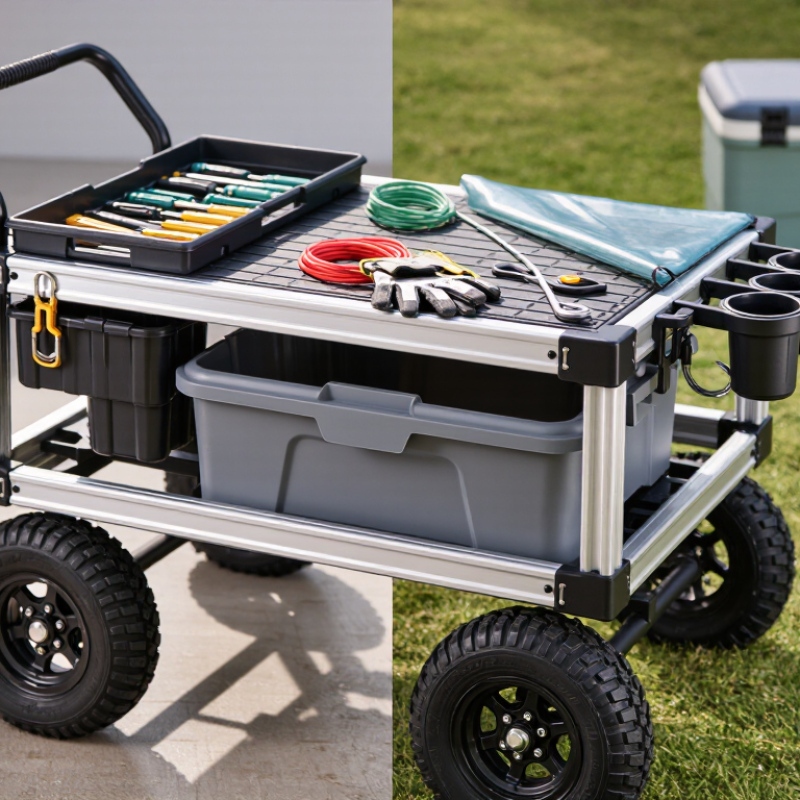
Utility Cart Accessory Types and Their 2026 Work–Leisure Applications
Utility cart accessories work best when matched to the route, load, and user. For warehouse or workshop tasks, locking casters, ergonomic handles, removable bins, and shelf dividers help keep tools and small parts controlled. A washable liner can contain spills, while a brake helps steady the cart during loading. These features matter in busy spaces. The U.S. Bureau of Labor Statistics reported 2.4 recordable injury and illness cases per 100 full-time workers in private industry in 2023. That figure does not measure cart-related incidents, but it reinforces the value of safer handling and organized work areas.
For leisure, the same cart may need different details: a weather-resistant cover, a cooler insert, quiet wheels, or a cup holder for picnics and community events. The Outdoor Industry Association’s 2024 Outdoor Participation Trends Report counted 175.8 million U.S. participants in outdoor recreation during 2023. That broad participation makes portable storage useful beyond workplaces, from park gatherings to garden projects. A cup holder sounds minor. It can still prevent drinks from tipping over on uneven ground.
Choose accessories that fit the cart’s stated load capacity; add-ons also add weight. Check wheel clearance, handle reach, and whether bins stay secure over bumps. It is easy to overfit a cart with extras. Test the setup on the actual route before relying on it.
2026 Top Utility Cart Accessories for Work and Leisure?
Payload, Stability, and Maneuverability Standards Under ANSI/ITSDF B56.8
A cup holder or storage basket seems light, but every accessory adds weight and may shift a cart’s center of gravity. ANSI/ITSDF B56.8 addresses safety for personnel and burden carriers, including safe operation and maintenance. It does not make every accessory combination automatically safe. Check the cart’s rated capacity and manufacturer guidance for the exact setup. Count the accessory, cargo, and occupants where applicable. Keep heavy items low and centered; a tall stack of tools can make turns less predictable.
Tips: Park on level ground before loading. Secure loose cargo, then test steering and braking at walking speed in a clear area. Watch for a changed turning radius or reduced ground clearance. Small details matter.
A field check helps, but it cannot replace the manufacturer’s limits or a qualified assessment. If an attachment blocks the driver’s view, catches on shelving, or makes the cart lean, remove it and reassess. Surfaces, slopes, and uneven loads change how a cart behaves. Honestly, a quick test may miss a problem that appears only when the cart is full. Review the applicable B56.8 edition, operating instructions, and inspection procedures before changing the setup. Keep the rated-load label visible, and record approved accessory configurations for regular users.
A practical comparison of commonly used utility-cart accessories. Added-mass figures are approximate planning ranges for accessory hardware only; actual weights and vehicle limits vary by cart design and configuration.
| Accessory | Approx. Added Mass | Payload Planning | Stability Considerations | Maneuverability Considerations | Work and Leisure Uses | ANSI/ITSDF B56.8 Check |
|---|---|---|---|---|---|---|
| Cargo net with attachment points | About 1–3 kg (2–7 lb) | Low accessory mass; include it in the vehicle’s configured-weight assessment where applicable. | Helps restrain loose items. Keep cargo low and within the bed or platform limits. | Usually has little effect when fitted without protruding straps or loose sections. | Tools, sports equipment, picnic supplies, and other lightweight cargo. | Confirm secure attachment and that the net does not obstruct controls, visibility, or required access. |
| Fold-down side rails | About 5–12 kg (11–26 lb) | Account for the rails when checking available payload and the cart’s rated load. | Can help contain cargo, but do not raise or stack loads above the cart’s permitted load height. | Check rail width and folded position for clearance through aisles, gates, and doorways. | Material handling, gardening, and carrying bags or bulky items. | Verify that rails latch securely and do not interfere with safe entry, exit, or operation. |
| Cargo-bed liner | About 3–8 kg (7–18 lb) | Its mass is modest but should be included in configuration and payload calculations as directed by the vehicle manufacturer. | A fitted, non-slip liner can reduce cargo movement; it does not replace load restraint. | Typically minimal effect; ensure the liner does not obstruct drainage or moving parts. | Landscaping, maintenance work, and transporting items that may scratch or soil the bed. | Check compatibility, retention, and any effect on the cargo bed’s rated load. |
| Weather canopy | About 8–20 kg (18–44 lb) | Include the canopy and its supports in the approved vehicle configuration and load assessment. | Raises the profile and may increase sensitivity to wind; keep the load secure and follow operating limits. | Can reduce overhead clearance and visibility; check turning paths and access through covered areas. | Outdoor facilities work and passenger protection from sun or light weather, where the vehicle is designed for it. | Confirm the complete canopy installation is approved and does not impair visibility, operator protection, or safe operation. |
| Tow coupling or hitch | About 2–6 kg (4–13 lb) | Towing capacity is separate from the cart’s carried-load rating; use only specified drawbar and trailer limits. | Trailer tongue load and trailer movement can affect vehicle stability. Follow the vehicle’s towing instructions. | A trailer increases turning space and stopping distance; allow for off-tracking when turning. | Moving compatible trailers or equipment on approved routes. | Use only an approved coupling and vehicle configuration; observe applicable towing and operating limits. |
| Tie-down rings or anchor points | About 0.5–2 kg (1–4 lb) per set | Low mass, but the anchors and cargo-restraint method must be suitable for the load and vehicle. | Proper restraint helps prevent shifting; position heavy cargo low and near the center of the platform. | Normally negligible if hardware is recessed or placed clear of wheels and controls. | Securing toolboxes, containers, and other loads during travel. | Confirm anchor locations and strength are approved; do not exceed the vehicle or restraint-system ratings. |
| Warning beacon or work light | About 1–4 kg (2–9 lb) | Small mass; account for mounting hardware and any additional electrical load. | Mount securely and avoid placing equipment where it can snag or create an overhead hazard. | Check that the installation does not block the operator’s view or increase vehicle width unexpectedly. | Visibility in work areas and illumination for low-light tasks, where permitted. | Verify electrical compatibility and that lights do not interfere with required safety devices or visibility. |
| Replacement tire set | Varies by tire type and size; compare the complete set with the original equipment | Do not assume a tire change preserves the original load rating; confirm tire and vehicle ratings. | Tire type, pressure, and diameter can affect traction, ground clearance, and handling. | Different tread or rolling resistance may change steering effort and turning behavior, especially on soft or uneven ground. | Selecting suitable tires for paved paths, workshops, or compatible outdoor surfaces. | Use dimensions and specifications approved for the vehicle; recheck clearances and operating instructions. |
Standards and safety note: ANSI/ITSDF B56.8 addresses personnel and burden carriers; it does not provide a universal accessory-weight allowance or a single payload value for every utility cart. Confirm the applicable standard edition, vehicle rating plate, approved configuration, and manufacturer instructions. Keep loads within rated limits, evenly distributed and secured, and assess the complete vehicle after any modification.
A utility cart can reduce carrying, but poor setup may simply move the strain. The Bureau of Labor Statistics reported 502,380 work-related musculoskeletal disorder cases involving days away, job transfer, or restricted duty in 2022. OSHA’s ergonomics guidance recommends reducing force, awkward postures, and repetitive motion. Small choices matter.
Start with a handle that lets workers push with a neutral wrist, then check that the cart rolls smoothly when loaded. Swivel casters help in tight aisles; reliable brakes help during loading. Add a low, secure rail or strap for items that might shift over thresholds. Keep heavy supplies near the cart’s center and at a height that avoids deep bending. No accessory fixes an overloaded cart. That part is easy to overlook.
Use a simple inspection routine: test the brakes, look for damaged wheels, and check that handles and fasteners feel secure. OSHA guidance supports evaluating tasks and equipment in their actual work setting, not assuming one configuration fits every worker. A cart used outdoors may need different wheels from one used on smooth floors. Track near misses and worker feedback, too; injury reports rarely show every awkward push. The data is useful, but imperfect.
A dependable utility cart needs more than a power strip and a bright lamp. Choose a power system rated for its intended load, and check the voltage, current, and installation instructions. A UL mark can indicate that a specific product was evaluated to applicable safety requirements; it does not automatically certify the entire cart or every attachment. Keep cables away from wheels and pinch points. A loose cord can become a real hazard.
For lighting and charging outdoors, check the accessory’s IP rating and the conditions it was tested for. The rating describes resistance to dust and water ingress, not impact strength or electrical safety. An IP-rated enclosure still needs properly sealed cable entries and a closed cover during use. Avoid charging devices in direct rain, and leave space around chargers for heat to escape. I have seen tidy wiring become messy after one busy shift, so allow room for inspection and repair.
Tips: Match the outlet and charger to the device, secure connectors against vibration, and inspect cables for cuts or flattened spots. Test the setup with the cart loaded and moving slowly. If a light flickers or a plug feels warm, stop and investigate rather than accepting it as normal.
Leisure accessories change how a utility cart performs outdoors, but weather resistance, usable capacity, and lifetime cost matter more than appearance. A fitted canopy can shade a picnic lunch, yet thin fabric may sag after repeated rain. Look for water-resistant materials, sealed seams, and corrosion-resistant fittings. Water-resistant is not waterproof. That distinction matters.
Cooler inserts and insulated bags add useful capacity for drinks and food, but they also consume cart space and add weight. Check the accessory’s load rating alongside the cart’s limit, especially on soft grass or uneven paths. A removable seat offers a place to rest, though bulky frames can make storage awkward. Measure your cart before buying; dimensions listed online can be surprisingly easy to misread.
Compare total cost over several seasons, not just the checkout price. Include covers, cleaning supplies, replacement straps, and storage needs. A cheaper fabric organizer may cost less upfront but fade or tear sooner in full sun. Higher-priced, UV-resistant material can be better value if it lasts longer, though actual lifespan depends on care and exposure. I would still inspect stitching and fasteners in person when possible. Small details matter. A practical setup is often lighter and simpler than expected.
Locking casters, ergonomic handles, removable bins, and shelf dividers control tools and small parts. A washable liner contains spills. A brake steadies the cart during loading.
Choose a weather-resistant cover, cooler insert, quiet wheels, or cup holder for parks and garden projects. A cup holder can stop a drink tipping on uneven grass.
Yes. Every basket, bin, and holder adds weight and may shift balance. Count accessories and cargo together. Keep heavy items low and centered.
Test the loaded cart on its actual route at walking speed. Check steering, braking, wheel clearance, handle reach, and turning radius. A quick test can miss trouble when the cart is full.
Use a handle supporting a neutral wrist and wheels that roll smoothly under load. Keep supplies centered and within a comfortable reaching height. No accessory fixes an overloaded cart.
Low rails, straps, removable bins, and dividers can stop items shifting across thresholds. Do not block the operator’s view. Remove attachments that catch shelving.
Test brakes, examine wheels, and check handles and fasteners before use. Look for leaning, loose parts, or reduced ground clearance. Small defects can become inconvenient quickly.
Smooth floors, slopes, grass, and uneven paths demand different wheel choices. Tight aisles favor swivel casters. Outdoor routes may need more clearance. A cart can behave differently on the same day.
Utility Cart Accessories For Work And Leisure can transform a basic cart into a more capable, comfortable, and versatile tool. In 2026, useful options range from dividers, bins, and tie-downs for organizing work materials to seats, weather covers, and storage pockets for recreational outings. Choose accessories that suit the cart’s payload and preserve stability and maneuverability. The principles of ANSI/ITSDF B56.8 can help guide safe selection and use by encouraging attention to rated capacity, balance, and control.
For worksites, ergonomic handles, secure load restraints, and easy-access storage can help reduce awkward lifting and improve everyday safety. Electrical accessories such as lights, power supplies, and charging systems should be selected with appropriate UL-related safety considerations and IP ratings for the expected exposure to dust or moisture. For leisure use, compare weather resistance, carrying capacity, ease of installation, and total cost over time. Matching accessories to the task and environment helps make a cart practical across both work and recreation.
Mingni Golf Carts